
Spinal Cord Injury: Enhancing Function with Neurac Therapy
Systematic Review and Meta-Analysis Synopsis
By Kjartan Vårbakken, Physical Therapist (HVL), MSc (UiB), PhD-course certified (NTNU), Certified Neurac Practitioner, Head of Research & Development, Redcord AS
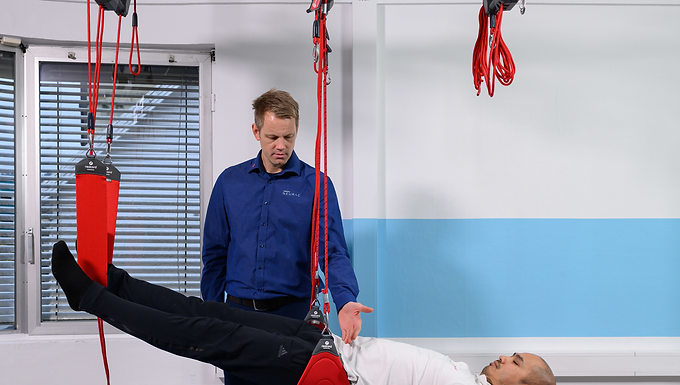
Suspension Exercise Training (SET) has been shown to improve lower-limb motor function, walking, balance, and daily function after spinal cord injury, according to a new systematic review and meta-analysis published in the Journal of Orthopaedic Surgery and Research (Li et al., 2025) [1].
This review provides some of the strongest RCT-based evidence to date that sling-based suspension exercise—closely aligned with the neuromuscular activation principles used in Redcord’s Neurac Therapy—can be a useful adjunct in spinal cord injury rehabilitation [1]. Sling Exercise Therapy and the Neurac Method were first described by Redcord [2,3].
Introduction
Spinal cord injury (SCI) can lead to long-term motor, sensory, and autonomic impairment. Suspension exercise training (SET) is a form of sling-based exercise that uses body support and instability to challenge neuromuscular control during rehabilitation.
The current synopsis summarizes a systematic review and meta-analysis by Li and colleagues that evaluated whether adding SET to usual rehabilitation improves function after SCI (1).
Methods
Li and colleagues conducted a systematic review and meta-analysis in line with PRISMA guidance. The protocol was registered in PROSPERO (CRD42024606161) (1).
They searched eight databases (PubMed, Web of Science, Embase, Cochrane Library, CBM, CNKI, WanFang, and VIP) from inception to October 20, 2024. The authors included randomized controlled trials (RCTs) in which the control group received conventional rehabilitation and/or medication, and the experimental group received the same care plus SET (1).
Across trials, SET was often described at a program level rather than with reproducible exercise details. Some studies combined SET with other co-interventions (e.g., electroacupuncture, electromyography biofeedback, virtual-scenario cycling training, or traditional Chinese medicine). Intervention duration ranged from about 1.5 to 3 months (1).
SET frequency appeared high in several trials, ranging from once daily to three times daily, often 5 to 6 days per week. However, reporting of session length, exercise selection, progression rules, and intensity was inconsistent. This limits dose interpretation and replication (1).
Risk of bias was assessed using RoB 2. Certainty of evidence was graded using GRADE (1).
Results
Thirteen RCTs were included, with 883 participants in total. All trials were conducted in China. Participants were broadly middle-aged, and most trials included more men than women (1).
Control conditions varied but generally reflected conventional rehabilitation with or without additional therapies or medication. The experimental groups received the same baseline care plus SET. This makes the evidence most applicable to SET as an adjunct to standard SCI rehabilitation (1).
Pooled effects for SET plus usual care versus usual care were as follows (1):
· Lower-limb motor score (ASIA Lower Extremity Motor Score, ASIA-LEMS): weighted mean difference (WMD) +3.65 (95% CI 2.35 to 4.96; I² = 3.3%).
· Step length: standardized mean difference (SMD) 0.66 (95% CI 0.46 to 0.85; I² = 13.6%).
· Step speed: SMD 1.06 (95% CI 0.53 to 1.58; I² = 84.5%).
· Step frequency: SMD 1.00 (95% CI 0.51 to 1.49; I² = 82.4%).
· Balance (Berg Balance Scale, BBS): WMD +6.15 (95% CI 5.02 to 7.29; I² = 66.9%).
· Activities of daily living (Modified Barthel Index, MBI): WMD +12.48 (95% CI 5.86 to 19.09; I² = 93.2%).
· Muscle tone (Modified Ashworth Scale, MAS): WMD −0.76 (95% CI −0.88 to −0.63; I² = 6.6%).
Egger tests did not indicate statistically significant publication bias for the main pooled outcomes assessed (ASIA-LEMS, step length, step speed, step frequency, and BBS) (1).
No serious adverse events were reported. The authors cautioned that safety inference is limited because adverse events were not reported in the included trials and sample sizes were relatively small. No follow-up assessments were available, so the durability of effects beyond the intervention period is unknown (1).
All included trials were rated as “some concerns” on RoB 2. Allocation concealment was not reported in any trial, and several trials had incomplete reporting of randomization procedures (1).
GRADE certainty was moderate for step length, low for ASIA-LEMS, BBS, and MAS, and very low for step speed, step frequency, and MBI (1).
Discussion
Several outcomes improved in favor of SET, but certainty varied by outcome and heterogeneity was high for key measures. This means the direction of benefit appears consistent, while the typical size of benefit is uncertain for some outcomes (1).
Lower-limb motor score [ASIA-LEMS] improved by about 3.7 points out of 50. This is a small-to-moderate average change. It may still be clinically noticeable if it helps an individual progress in task practice, such as stepping, standing, or transfers (1).
Balance improved by about 6.2 points on the 56-point balance scale. This magnitude may be noticeable in clinical balance tasks. However, heterogeneity was substantial; so, improvements may vary by protocol and patient subgroup (1).
Muscle tone improved by about 0.76 MAS grades. A change of this size can be noticeable during handling and movement, but MAS is an ordinal scale and should be interpreted together with functional outcomes (1).
Step length had moderate-certainty evidence and low heterogeneity. In contrast, step speed, step frequency, and MBI had very high heterogeneity and very low certainty. These results suggest that some large pooled effects may not generalize well across settings and interventions (1).
From a method quality of reviews perspective (AMSTAR 2), the review reports several strengths, including protocol registration, a broad database search, duplicate screening and extraction, and the use of RoB 2 and GRADE. A key limitation is limited intervention detail and incomplete transparency around excluded studies beyond the flow diagram. Overall, confidence in the precision of the effect estimates is low, despite a plausible direction of benefit (1).
In OCEBM (2011) terms, the evidence base is Level 1a by design because it is a systematic review of RCTs. However, the outcome-specific GRADE ratings indicate that clinicians should be most confident in step length, while other outcomes remain promising but uncertain (1).
Conclusion
Based on 13 RCTs, adding SET to conventional rehabilitation is likely to improve step length. This represents a moderate standardized improvement in gait mechanics with moderate-certainty evidence. SET may also improve lower-limb motor function, balance, and muscle tone with low-certainty evidence (1).
Large pooled effects were reported for step speed, step frequency, and activities of daily living ability. However, these findings are very uncertain because certainty is very low and heterogeneity is substantial. The true clinical benefit may be smaller. Or, it may vary widely by protocol and patient subgroup (1).
Higher-quality, multicenter RCTs with standardized SET dosing, follow-up, and transparent adverse-event reporting are needed to confirm the magnitude, durability, and patient-important impact of these improvements (1).
References
1. Li Y, Wu M, Pan J, Zhu L. Efficacy of suspension exercise training in spinal cord injury: a systematic review and meta-analysis. J Orthop Surg Res. 2025 Jul 8;20(1):627. doi:10.1186/s13018-025-06044-z. PMID: 40629468. PMCID: PMC12235867. Abstract: https://pubmed.ncbi.nlm.nih.gov/40629468/ Free full text: https://pmc.ncbi.nlm.nih.gov/articles/PMC12235867/
2. Kirkesola, G., Neurac - a new treatment method for long-term musculoskeletal pain. Fysioterapeuten, 2009. 76(12): p. 16-25. English version: http://cdn1.sourze.se/cdn.zitiz.se/userfiles.cdn.zitiz.se/z/caea9cc5-b663-44ec-b91d-cccabcafc571/Neurac%20Article%20Fysioterapeuten%20200912.pdf , Norwegian version: https://www.fysioterapeuten.no/neurac---en-ny-behandlingsmetode-for-langvarige-muskelskjelettplager/123559
3. Kirkesola, G., Sling exercise therapy (S-E-T): a total concept for exercise and active treatment of musculoskeletal disorders. Fysioterapeuten, 2000. 12(6): p. 7. English version: [link in progress]